http://www.onlinedegree.net/the-10-oldest-books-known-to-man/
Enjoy!
Thanks Ann, for the link.
Thursday, April 22, 2010


Solo by Rana Dasgupta


Set in Bulgaria, a country that has been culturally and politically isolated since the World Wars, the story opens with a blind 100 year old man, Ulrich, who lives alone in an apartment in Sofia. The entire narrative is his life, his failed life which is analogous with his country which has failed too.The narrative is the story of the 20th century which has failed some countries while the others have spurted past.
The scale of the novel is epic in its expanse, both the time span it encompasses and the perspective. The novel is divided into two halves. In the first half we get to know the story of Ulrich who had promise as a musician and a scientist in his early life, but through fate and circumstances was destined to end up a nobody with a failed life, a failed marriage.
He lives out his final years, blind and alone in a cramped apartment on the busy streets of Sofia, keenly aware of the cacophony of street sounds which intrude on his reflections. His neighbours care for him, and his mind is on its on journey through his past and into the future.
It is the ordinariness of Ulrich's life which is what makes the narrative fascinating. The story flows into the past where we see Ulrich growing up in a prosperous Sofia, where his parents have great hope for him, except that his father is violently against his love for music. This has a parallel with the state where communism blanked out all forms of cultural heritage, including music.
His father becomes a shell of man post his experiences in the wars, and Ulrich goes to study chemistry in Berlin in the 1920s, and unfortunately is compelled to return home to a job at a factory. His marriage fails, and his wife moves away with his son. His mother is sent to a labour camp and returns traumatised. Ulrich becomes a star worker in the great five year plan of the state and works until retirement, where he is handed a golden watch for his years of service. He accidentally blinds himself with acid. Whis is the catalyst for his daydreaming in his dark world. The book moves into part two. The second half of the story follows three youngsters with no apparent obvious connection to Ulrich. Boris, a gypsy, Khatuna, a gangster's mistress and her brother Irakhli, who is a poet and whose poetry makes an appearance through the second half which is set in New York. Ulrich walks into their lives, where he also meets up with his long dead first love from Berlin, a Jewish girl who was killed in the holocaust.
Solo is a strange, haunting and powerful book. It takes ordinariness, shakes it, dissects it and presents it to us for our consumption. Solo, the title, comes from the protagonists life, which is a metaphor for all our lives, which will end, solo. Add to this brilliant writing which takes us through 100 years in a country's history through the eyes of an individual.
Reviewed by Kiran Manral
Wednesday, April 21, 2010
My Review : Persepolis

I was deeply moved after reading Marjane Satrapi's autobiographical graphic novel written in black and white Persepolis some days ago.The book gives you a glimpse of life in Iran through the eyes of a woman.It was fascinating to read Satrapi's first hand account of what the country went through after the fall of the Shah,the early years of Ruhollah Khomeini and the first years of Iran-Iraq war.
Persepolis details Satrapi's life during the war between Iran and Iraq. Persepolis depicts Satrapi's childhood in Iran, and Persepolis 2 depicts her high school years in Vienna, Austria and her return to Iran where Satrapi attended college, married, and later divorced before moving to France, where she now lives
My Review :Piggies On The Railway
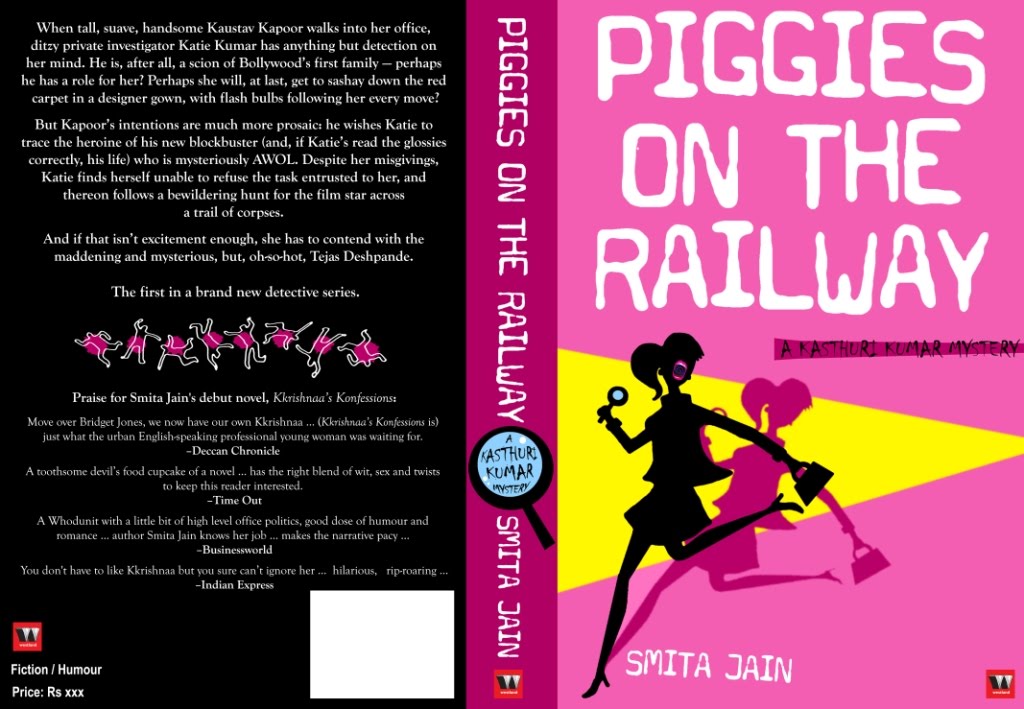
This book is a chicklit + crime mystery rolled into one!If are looking for an Agatha Christie kind of a detective novel sorry that this book ain't but what you get is mystery,romance,humour all packaged in one novel! It sure is a fun read must read for all the ladies out there!The book was a page turner not just for whodunnit but for a few laughs as well !
The protagonist of the book is Kasthuri Kumar who prefers to be known as Katie.She is a PI and is approached by the handsome,tall and suave Kaustav Kapoor who also happens to be the head honcho of Bollywood's leading production house to help him find the lead actress of his upcoming home production 'Ransom'. The actress has been AWOL after their shoot has wrapped up at Lonavala...so what follows is a hunt for Urvashi.So that is the mystery angle.While she is hunting for Urvashi murder comes close to home when her ex-boyfriend's wife is found dead in her friend's parlour!Who are the killers ,are the two deaths linked if yes why what is the connection between the two deaths...
Kasthuri ...oops sorry Katie is not your regular boring PI's she is smart,sassy,uber cool lady who knows what she wants from life.She is a keen fashion and bollywood follower who rides a Royal Enfield!During the course of the investigation she comes across Tejas Deshpande who is the head of security of Kaustav's production house.He is very mysterious and to make matters worse Katie finds herself terribly attracted to him and has a small crush at the same time for the very much married Kaustav.
The end is pretty predictable and you want the author to almost jump to the end of the story rather than delving on Kaustav's wife's lesbian relationship,Neena's motive,Katie's lusty neighbor,the manager's drunken act,..all though vital to the story's mystery build up but excessively delved into.
All in all the book is fun and a good light read...
Do read our interview with the writer Smita Jain here
A chance to write for the Chicken Soup's India Series
This is an opportunity for all the budding writers out there as well as for all the non-writers to come and share their story for the Chicken Soup India Series....Here's the brief
Message from Baisali :
Brief for “Chicken Soup for the Indian Friend’s Soul”
Publishing house: Westland
Try and state specific episodes as to why you think that the person you are writing about deserves to be in the Chicken soup series.
Please send your stories to:
bchattdutt@gmail.com or baisali.cd@gmail.com
Last dates for accepting submissions: August 30th 2010. But do try and send your stories ASAP for I will close as soon as I have selected my 101 stories for the same.
The write-ups will carry the contributor’s name. Westland pays Rs 1000 per story and two copies of the book. We carry a 3-4 line profile on all contributing authors. We accept blogged and published work too provided the authors get the reprint permissions. The copyright of the stories stay with the author.
Inviting stories for Chicken Soup for the Indian Friend’s Soul
Recipe for a winning “Chicken Soup for the Indian Friend’s Soul” story:
A Chicken Soup for the Soul® story is an inspirational, true story about ordinary people doing extraordinary things. They are personal and often filled with emotion and drama.
Chicken Soup stories have a beginning, middle and an ending that often closes with a punch, creating emotion rather than simply talking about it. A story that causes tears, laughter, goosebumps or any combination of these. A good story covers the range of human emotions. The most powerful stories are about people extending themselves, or performing an act of love, service or courage for another person.
Guidelines
1. Tell an exciting, sad or funny story about something that has happened to you or someone you know. Make sure that you introduce the character(s).
2. Tell your story in a way that will make the reader cry, laugh or get goose bumps (the good kind!) Don’t leave anything out — how did you feel?
3. The story should start with action; it should include a problem, issue or situation. It should include dialogue and the character should express their feelings though the conflict or situation. It should end in a result, such as a lesson learned, a positive change or pay-off.
4. Above all, let it come from your HEART! Your story is important!
Story Specifications
1) Stories should be non-fiction, ranging in length between 300-1200 words.
2) Chapters/Themes
• Chaddi Buddy – That first friend
• Through Thick and Thin – The one who has cheered your up's and shared your down's
• An Angel in Need – The one who enters your life for a very specific purpose
• Soulmates – The one who starts out by being a friend and ends up being a spouse
• Unusually Yours – Unique and unusual friendships
• Lost and Found – Friends who enter your lives again after ages.
P.S Please forward this mail to friends and family who are interested in submitting stories!
Monday, April 19, 2010
Q&A with Ashwin Sanghi


We got a chance to pose a few questions to Mr.Ashwin Sanghi with regards to his first book 'The Rozabal Line' which has the distinction of being on India-Today's bestseller list for four consecutive months.Did you know that the book was originally published in 2007 under his pseudonym, Shawn Haigins, an anagram of his real name?The book was subsequently published in 2008 in India by Tata-Westland under his own name.Ashwin Sanghi's second novel, a political thriller with a historical backdrop is to be released later this year.
An entrepreneur by profession, Sanghi writes extensively on history, religion and politics in his spare time but writing historical fiction in the thriller genre is his passion and hobby.Sanghi was educated at Cathedral & John Connon School, Mumbai and St. Xavier’s College, Mumbai. He holds a masters degree from Yale and is working towards a Ph.D. in Creative Writing from the University of Wales.
He lives in India with his wife, Anushika, and son, Raghuvir.
Ashwin can be reached either via his blog at www.ashwinsanghi.com or via Twitter at www.twitter.com/ashwinsanghi
So here goes ...
How did the concept of writing a book on the myth about Jesus Christ settling down in Kashmir post crucifixion come about?
In early 1996, I came across a book called Holy Blood Holy Grail by Michael Baigent, Richard Leigh, and Henry Lincoln. The book subsequently went on to become a bestseller but it was my first exposure to the notion that the historical Jesus Christ may have been rather different to the one portrayed in the gospels and that Jesus may have been a married man who had children.
A couple of years later, I read Holger Kersten's book, Jesus Lived in India and was fascinated with the idea that Jesus could have been inspired by Buddhism and that he may have drawn much of his spiritual learning from India. I found Kersten’s research to be meticulous and I soon ended up marrying the two theories from these two books in my mind. What if Jesus traveled to India and left a bloodline in India? At that moment I knew that I simply had to write a book about it. Given the fact that this was simply a “theory”, the book necessarily had to be fiction.
I began to delve deeper into the story and came across several startling coincidences. For example, just outside the Rozabal tomb in Srinagar (the tomb that several researchers believe is the final resting place of Jesus) is a pair of carved feet. What’s remarkable, however, is that the feet bear crucifixion marks. The Bhavishya Mahapurana one of the oldest Hindu scriptures cites the presence of Issa in Kashmir during the reign of the Kashmiri king Gopadatta. The Shankracharya temple (in Srinagar) bears a carved inscription that specifies the very date of which “Yuz Asaf” (son of Joseph) became a prophet. All of these facts were simply astounding and I soon began to realize that there was a wealth of information that needed to be retold in a format that made for an enjoyable ride.
My true fascination, however, was with what could possibly have happened before Jesus Christ was born, not after. My interest went back to the possibility that the Hebrew patriarch Abraham may have been one and same as the ancient Hindu god of creation, Brahma. After all, Abraham’s wife was Sara and Brahma’s consort was Saraswati. There were very close linkages between the Sumerian civilization and the Indus Valley Civilization, and hence it was not an unreasonable hypothesis that one of the lost tribes of Israel may have seen India as their spiritual home. Hundreds of such possibilities led me to conclude that it would have been plausible for Jesus to view India as a land of healing and learning.
Thus I knew that I was writing a work of fiction that was strongly anchored in fact, but religion is a matter of personal faith. What I believe may not be what you believe. Rather than present a work of non-fiction that would be relegated to dusty library shelves I wanted to write a thriller that would present all of these interesting tidbits of information as part of a racy story and thus the idea of The Rozabal Line was born.
The book must have involved extensive research. What did your research entail and how long did it take you to actually put all the information required for the narrative together?
I am neither a scholar nor a researcher, simply a fiction writer, that too of the racy formulaic variety. I have never been able to appreciate or understand literary fiction and thus my writing is targeted at wider audiences who want a fast-paced read that also educates along the way.
My problem in writing The Rozabal Line lay in the fact that there was too much information, not too little. A wealth of information was already available in excellent books that had covered various issues such as the Jesus in India hypothesis, the historical Jesus, and the interplay of mythologies and religious beliefs in the evolution of the character of Jesus. Books such as Jesus Lived in India by Holger Kersten, Jesus in Kashmir: The Lost Tomb by Suzanne Olsson, The Fifth Gospel by Fida Hassnain, The Unknown Life of Jesus by Nicolas Notovich and The Lost Years of Jesus by Elizabeth Clare Prophet were very important in building the framework of the story. A seminal work in Urdu by Hazrat Mirza Ghulam Ahmad was also critical. Other books such as The Christ Conspiracy: The Greatest Story Ever Sold by S. Acharya and The World’s Sixteen Crucified Saviours by Kersey Graves were important from the angle of building an “alternative hypothesis” around the canonical Jesus. I found that the “Tomb of Jesus” website and several other online communities not only had references to many sources but also had free-flowing opinions and views of readers and contributors. Many of these reader and researcher comments also helped me build the fictional element of The Rozabal Line.
A persistent problem, however, remained: The “Jesus in India” theory being presented in a 100,000 word paperback implied that there was simply too much information and far too little space to cover it all. Over the eighteen months that I spent writing the novel, my biggest limitation was that I wanted the reader to be able to experience as much of the history around the story. The Rozabal Line has, thus, been written in a very different format in which fiction and history appear as alternating passages in a time warp. It is also one of the very few paperback novels in which you find end notes to explain the sources from which the material is derived. All of these elements make The Rozabal Line a very different read to other novels. The result is that you can either love it or hate it, but you can’t ignore it.
'The Rozabal Line' is a conspiracy thriller much on the lines of The Da Vinci Code? How has the response to this book been in India and globally?
The book was written by me in 2005-2006. Over the next twelve months my manuscript would reach over one hundred literary agents in America, England and India and would be turned down by all of them. Eventually out of sheer desperation I self-published the work in 2007 and the novel sold surprisingly well, clocking over 700 copies in a few months on Amazon.com. The moderate success of the self-published book led to Tata-Westland offering me a publishing deal specifically for India. A new revised edition of The Rozabal Line went on sale in November 2008 in India and remained on India Today’s bestseller list for the next four months. A viral video trailer on YouTube attracted a great deal of attention and so did the fact that the first chapter of the book was available from day one as a preview download on Scribd. My blog became extremely active and very soon, The Rozabal Line had a cult following. As we speak, The Rozabal Line, has been contracted by a Turkish publisher for producing a Turkish translation. Later this year, Tata-Westland shall also be reintroducing the book through a mass-market paperback. I am overwhelmed by the response that my book has received and am truly grateful to readers and God almighty!
What is your advice to anyone wanting to write a conspiracy story/thriller?
I guess the question can be broken into two parts: (i) what advice do I have to offer to a first-time novelist and (ii) if the novelist in question is interested in conspiracy fiction then what pointers could I possibly offer.
My answer to the first part is that one simply needs to have faith. Writing is a very lonely activity and getting published is an extremely demoralizing one. I received a hundred rejections before finalizing a publishing deal. Most first timers tend to give up because of this continuous rejection process. What all aspiring novelists must understand is that writing is a creative industry and there’s no creative industry that does not put its players through trial by fire. Imagine a young man from a village landing up in Mumbai hoping to make it big in Bollywood. What are the knocks that he would necessarily have to accept to make any sort of breakthrough? The trials and tribulations of all creative pursuits—music, writing, cinema, theatre, art—are pretty similar. The ones who make it are the one who hang in there long enough.
That brings me to the second part of your question: what specific advice do I have for anyone wanting to write conspiracy fiction. Well, you simply need to love your subject. If you love the subject enough you will be disciplined enough to do meticulous research and that is fundamental to writing good conspiracy fiction because it needs to be as close to the truth as possible.
I love anything that has the faintest whiff of conspiracy, and in fact, so do most people. Who was behind the assassination of John F. Kennedy? Was the first walk on the moon just a scam or did it really happen? Did Hitler commit suicide in his bunker or did he escape? Were Jesus and Mary Magdalene married? What happened to Netaji Subhash Chandra Bose? Anything that allows us to question conventional wisdom and allows us to explore a more mysterious (and obviously much more delicious) explanation is a fiction writer’s delight. My own view is that the intercourse between fact and fiction is what makes for truly interesting fiction (and interesting fact). Personally, I prefer reading fiction that sounds like fact and fact that sounds like fiction. The publication of The Rozabal Line has strengthened my view that those who like my variety of fiction are those who wish to read fiction that sounds very much like The History Channel, CNN and 60-Minutes blended together.
What are you working on next?
I have completed my second novel and I hope that it should be published by November 2010. The story is a political thriller but with a historical context. History fascinates me and hence the strong presence of a historical backdrop is likely to be a recurring feature in all my novels. Without giving away too much, it revolves around two central characters, evolves from a historical relic, involves juicy secrets around an archaeological find, and dissolves with the satisfactory resolution of a murder!
I believe you are committed to the upkeep of the Rozabal shrine, could you tell us a little more about your involvement with this shrine?
My commitment to the shrine is that I have pledged that any monies that are earned by me from book sale royalties will be contributed by me to helping the shrine, its environs and local populace. At this moment, however, the law and order issues in J&K as well as the adverse reaction of the shrine management to outsiders has made it virtually impossible for me to do much. Instead, what I’m concentrating on doing is to accumulate royalties so that it may eventually result in a meaningful and significant contribution from me as a tribute to the man who lies buried within. Since the publication of The Rozabal Line, tourists have been flocking to the shrine and I hope that this momentum will see the shrine get the sort of international recognition that it deserves.
How do you reconcile your two roles, of a businessman and author? How do you make the time to write?
Being an entrepreneur provides me with material sustenance—my bread and butter. Being a writer provides me emotional sustenance—my jug of wine. It’s my way of reclaiming my sanity in an otherwise insane world. By nature, I’m an introvert and writing is a very lonely pursuit. I’m locked up inside my study at odd hours researching and writing about something that piques my interest. Thus, writing is an ideal pursuit for someone like me. Though I was born in a business family and was brought up with the usual doses of business inputs (schooling at Cathedral & John Connon, BA at Xaviers College, MBA from Yale), I remain a loner and academic at heart. Writing is merely an expression of that facet of my personality. I would be incomplete with either of those two sides missing. From 10am to 7pm I am a businessman but am a husband, father and writer for the rest of the day!
Saturday, April 17, 2010
Review of Chitra Banerjee Divakaruni's Queen of Dreams
Reviewed by Itchingtowriteblogs
I am on a Chitra Banerjee Divakaruni spree. I fell in love with her writing after reading Palace of Illusions. Such lucid style and hidden in that style is deep meaning.
All her books have a common thread - I am not talking of the Bengali backdrop- I am talking of the commonality that manifests in the form of dreams, power of stories or rather the power of a spoken word that takes a life of its own and within itself, carries a lesson. I love the way she says that everyone visualizes a story in a different way- sees it in their own mind through different filters. I think that is a great insight for everyday life also.
Digression alert- Just the other day the husband and I were discussing the shape of a cabinet I had in mind- I said L shaped, visualising a vertical L- tall in the corner, and short but horizontally extending to cover the width of the space. The husband argues that there is no space for an L shaped cabinet- he imagining a horizontal 2 dimensional L.
Queen of Dreams take the power of dreaming to a magical (supernatural?)
level. The story is built upon the idea that a dream is a telegram from the hidden world. And I interpret the hidden world to be the future, the unknown, the yet-to-happen, because they say the mind sees that which the eye cannot or refuses to see.
After reading the book, I tried to crystallise my thoughts. I realized that whichever angle I take to my review, I am bound to miss out some shades of the story. There are so many facets to it that it is difficult to put them on the same page without giving the entire story away. So I took the most obvious route -the protagonists point of view.
Rakhi is an artist living the typical American born desi life- American by birth but having a keen interest to know about her roots. Her paintings depict India as she imagines, her chai house is Indian as per her understanding of what is India.
Rakhi's mother has an incredible gift- the power to dream the dreams of other people, dream warnings and even dream lost dreams - dreams of people long gone. She seeks out people whose dreams she has dreamt and warn them of potential hazards.
But then, that is not what the story is all about. It has deeper significances as lot of reviewers point out- relationship between mother and daughter, the daughter's quest for her identity through her mother's journals, her struggle for survival post 9/11, and on top of that her love-hate relationship with her ex-husband.
The story flits from Rakhi's thoughts to her mother's journals swiftly in an almost ethereal fashion. After her mother's death, Rakhi finds her mother's journals. The journals answer most of Rakhi's questions about her roots- those which during her lifetime, her mother was never able to speak about. They explain about her struggle with her choices. Her struggle with herself to come to terms with the fact that to keep her gift intact, she had to give up on the most precious things in life which normally a woman or a person would choose- her family. Or perhaps in her case, her gift was the most important thing in her life- over and above anything or anyone else. Or perhaps she is not the stereotypical woman for whom the family comes first?
Some questions are left unanswered much to my annoyance, leaving me behind with a feeling of loose ends- I almost scraped at the book cover to see if some pages are stuck by the way!
Subscribe to:
Posts (Atom)